


Timely updates and zero-cost production of automotive parts company product catalogs and brochures
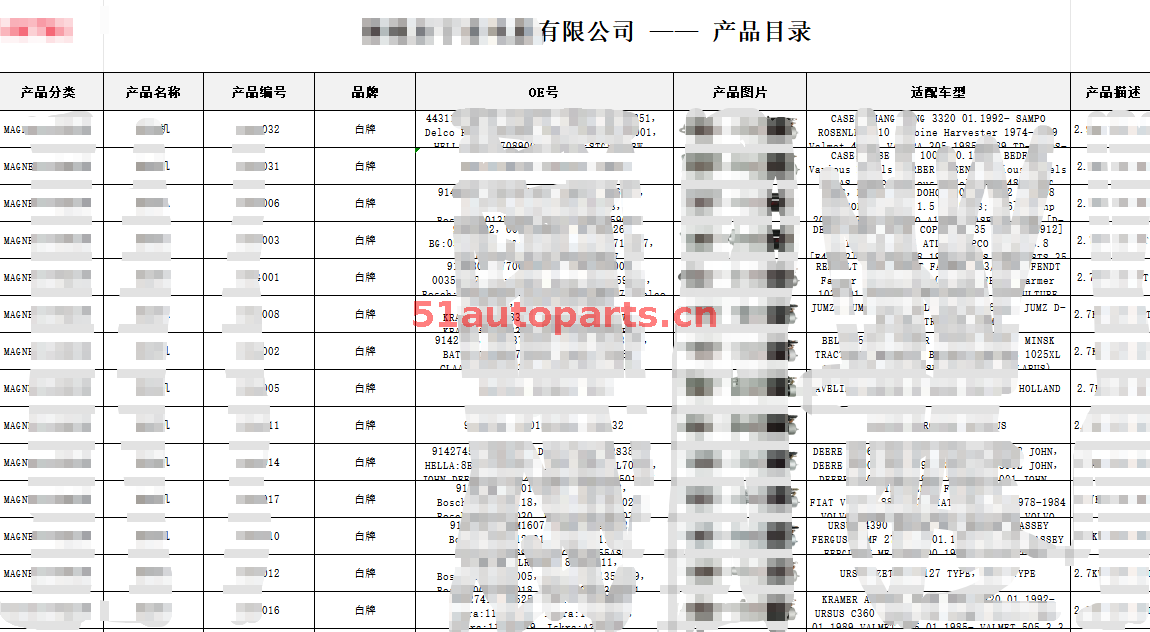
With the increasing number of automotive parts and components enterprises入驻ing our company, more and more clients have requested a function for generating product catalogs.
After integrating professional product catalog solutions in areas such as automotive OEM part numbers, compatible vehicle models (e.g., KIA Rio, Hyundai Tucson), and detailed technical parameters (e.g., compressor slot count, voltage), we directly addressed industry pain points by launching a practical and specialized automotive parts product catalog or product brochure feature. This feature supports one-click generation, range generation, custom fields, customizable visible data, and custom template generation.
The Automation Journey of Product Catalogs and Brochures
In the automotive parts industry, whether in the aftermarket (AM) or the original equipment manufacturer (OEM) segment, product catalogs are often considered the most overlooked "edge material." Many business owners view them merely as a pictorial book or a PDF, only to realize how this "small thing" can actually strangle a company when errors in catalog data lead to wrong shipments or lost major clients due to untimely updates.
After a thorough analysis, we discovered that automotive product catalogs or brochures can be produced with zero cost or without spending any money. We emphasize its importance while reducing the production cost to zero, supporting temporary updates, partial or full product inclusion, and instant production.
We all know that product catalogs and brochures are not only "sales weapons" but also "data assets." They have long transcended the scope of "product manuals" and play three core roles:
- It is a trusted "stepping stone": For overseas buyers or large chain repair shops, a professionally formatted and detailed data (such as clearly listing OEM numbers, compatible model years, compressor pulley slots, and voltage parameters) catalog is a direct reflection of the company's strength. The catalog is rough, and customers will directly question your quality control ability.
- It is a "silent guide" for sales: an excellent catalog can guide customers to discover your advantageous products. Through scientific classification and cross reference, the conversion rate of customers' orders can be significantly improved.
- It is the "core data asset" of enterprises: In the digital age, product catalogs are essentially a collection of structured data for enterprise products. It is the foundation for accessing large-scale automotive parts data platforms (such as automotive parts fast lanes), connecting with customer ERP systems, and even introducing AI options.
In the past, we often had to spend money to make picture books, but is it really worth the money? It is constantly facing a game of cost and mode.
Some people say it's worth it, some say it's inevitable to spend money, and some say it's not worth it, but whether it's worth spending or not actually depends on your approach.
Traditional model (heavy assets, high sunk costs). In the past, companies spent a lot of money hiring design companies for typesetting, professional photographers to take pictures, multilingual translation, and finally printed them into thick paper brochures or exported them as hundreds of megabytes in PDF format. This mode has extremely high single production costs, and once printed incorrectly or revised, the entire batch of materials will be directly scrapped, and the marginal cost cannot be reduced.
Digital mode (initial investment, diminishing marginal cost): Nowadays, more and more enterprises are turning to electronic catalogs (E-catalogs), online product systems, or API data interfaces. Now, the foreign trade management system of the automotive parts fast lane can complete "printing and typesetting" in just a few seconds, which is convenient and fast.
Thoroughly break the dilemma of rapid product iteration, frequent price fluctuations, frequent increase in OEM numbers, and temporary updates in the automotive parts industry.
With 92600-4 JM3B, 92600-9FE1D, 898037146, 92600VB11C, 883201A511, 898139936, 8831006440S, 8831012B20, 88320-0d070, 88320-60750, 92600IPTJIA, 88320-0k341, 88320-0K570, 88320-0k260, 883200K530, 88320-0k380, 88310-42560, 8831012820, 926003HNIC, 8832006320, 897371580, 88320-6a310, 92490-1LA0A, 92600-3XA1B, 926601LA2D, 88320-6a270, 88320-6a390, 88320-0k170, 883206A260, 883200C180, 898102824, 8832026730S, 92600-VC81C, 883200D070S, 8831002892S, 88410YC020, 88310-06441, 8832000070, 88310-33320, 8831048140S, 88310F2080 Taking these OE number data as an example, we can provide timely updates, generate in seconds, quickly correct errors, customize layout, and achieve multi image pricing.
At the same time, we reduce the complexity between data dimensions and achieve accurate matching of adaptation relationships and cross references. A car air conditioning compressor not only needs to clearly state its specifications (voltage, displacement, clutch model), but also needs to list dozens of OEM numbers and accurately match it to specific vehicle models (such as KIA Sportage 2.0L 2014-2018). Manually checking these data can easily lead to missing or mismatched items, causing customers to buy items that cannot be installed, resulting in high return and exchange costs.
Also, in the face of version confusion and serious information silos, we can generate and respond in a timely manner through second level generation. Even when there is an engineering change in the product (such as changing the pulley from 6 slots to 7 slots), as long as it is corrected, it can be generated again anytime and anywhere.
Faced with the nightmare of "localization" in multiple markets and languages, for overseas enterprises, the naming and model year division of the same car in different markets may be different (such as the Hyundai Tucson in the US, Europe, and the Middle East), but we can easily cope with it, supporting multiple languages such as English, German, Russian, and Arabic.
In summary, we have everything you can think of, and welcome everyone to experience it!