


Easily resolve the risk of inconsistency in cross-border trade documents in just 1 minute
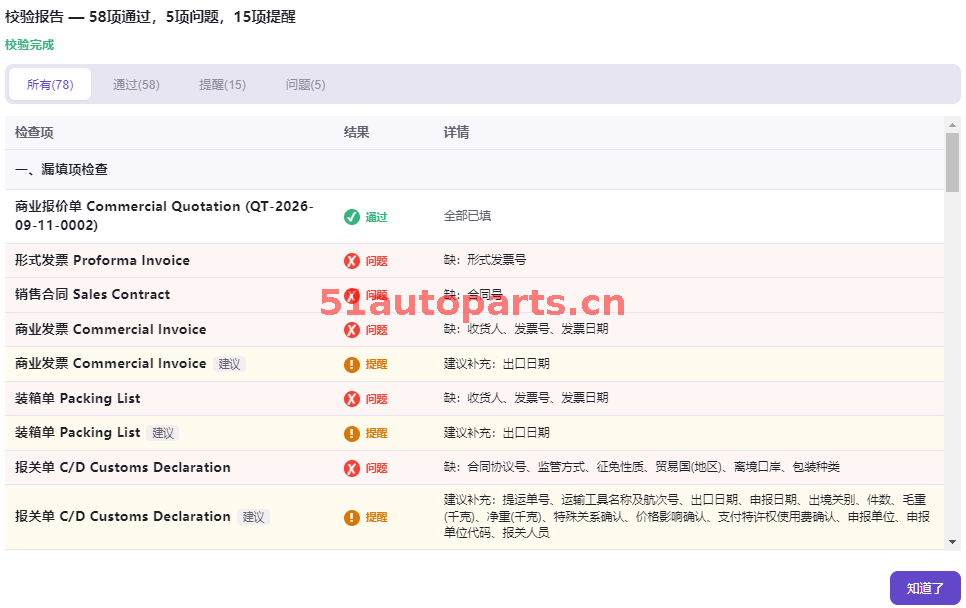
With the increase in the number of enterprises settled in, we have noticed that many of them have reported in their customer groups that they are prone to making minor mistakes in the process of foreign trade, and these small mistakes can often pose significant risks.
For example, when preparing documents, there may be inconsistencies in names, mismatched dates, incorrect spellings of invoice numbers 0 and O, and so on.
These minor details can lead to inconsistencies in documents, and in severe cases, the funds settled under the letter of credit may not be recoverable.
Ultimately, "document consistency" requires that all documents you submit to the bank (during letter of credit settlement) or customs (during customs clearance) must strictly comply with the requirements of the letter of credit/customs declaration on the surface, and there must be no contradictions between the documents.
Specifically, it encompasses two dimensions.
Document consistency: All documents must be fully consistent with the terms of the letter of credit (or customs declaration). Under letter of credit settlement, banks only consider the appearance of the documents. Even if there are discrepancies between the actual goods and the contract, as long as the documents are in order, the bank must make the payment; conversely, if there is even a single letter discrepancy in the documents, the bank has the right to refuse payment.
Consistency among documents: Descriptions of the same matter in different documents (such as invoices, contracts, packing lists, etc.) must be mutually corroborative and cannot be contradictory.
Here are some of the most common scenarios where mistakes are most likely to occur.
The most frequent issue is related to time and deadlines.
The presentation of documents has expired, either because it has exceeded the validity period of the letter of credit or the 21-day presentation period after the shipment date.
If the insurance policy date is later than the bill of lading date, etc., the insurance must take effect before the goods are loaded onto the ship. A policy date later than the bill of lading date is a typical discrepancy.
There are logical contradictions in the dates of various documents, such as the commodity inspection certificate date being later than the bill of lading date.
The second and deadliest issue is the conflict in core data.
The description of the goods does not match the letter of credit, and there are discrepancies between the product name and specifications on the invoice and the text of the letter of credit.
There is discrepancy between documents, with inconsistencies in quantity, weight, and amount on the invoice, packing list, and bill of lading. For example, the bill of lading shows 44,800 yards, while the invoice is prepared based on 50,000 yards.
Errors in port/location, incorrect display of loading port, destination port, and place of receipt, or non-compliance with the provisions of the letter of credit.
The third issue is the formal defects of the document itself.
For example, missing or inconsistent endorsements/signatures, forgetting to endorse the bill of lading or insurance policy, or the signing method not meeting the requirements.
Spelling and punctuation: Although minor spelling errors (such as "mashine" instead of "machine") may be overlooked, if they constitute a substantive difference (such as the addition of the "XYZ" number to a contract number), they will be identified as discrepancies.
The number of copies is incorrect. The letter of credit requires the submission of a full set of original bills of lading. It is not acceptable to submit only part of them.
Lastly, let me list another example of inconsistency between customs declaration and tax refund.
If the declaration of the customs declaration form does not match the actual goods in terms of product name, quantity, and specifications, it will not only affect customs clearance but may also be suspected of violating regulations.
Inconsistencies in the filing documents, such as conflicting information on customs declarations, purchase and sales contracts, invoices, and bills of lading, can raise doubts about the authenticity of the business from tax authorities, thereby affecting export tax rebates.
In general, when preparing documents, the requirements of the letter of credit should be taken as the sole standard, and the same information in all documents must be completely consistent.
Based on and not limited to the above scenarios and dilemmas, Auto Parts Expressway has launched one-click order and certificate generation, and provides leak detection for each order and certificate, as well as one-click verification for six certificates. We welcome everyone to register and use our service!